


MANSFIELD — Dan Crow stopped short Thursday of advocating for the Mansfield Water Main Initiative.
But the new Mansfield Fire Department chief made it clear his department’s firefighting efforts improve when the closest fire hydrant actually works.
“I’m not giving my opinion one way or the other, whether the initiative is a good idea or not. The citizens have to really decide how to prioritize their own dollars and what they want to decide with their vote,” Crow said.
“I’m just allowing the citizens to get as much information as they can to make the decision for themselves,” he said.
The fire chief was speaking to a group of residents and some elected officials at the Community Room of the Mansfield Richland County Public Library.
Crow was invited by local attorney Eric Miller, who leads the group pushing the water main initiative that will be back on the March 18 primary ballot, a quarter-percent municipal income tax increase that would help begin the process of replacing nearly 58 miles of century-old 4-inch water mains.
Miller has said there are 385 fire hydrants in Mansfield that cannot function properly due to the aging, small water lines, impacting 2,400 structures.
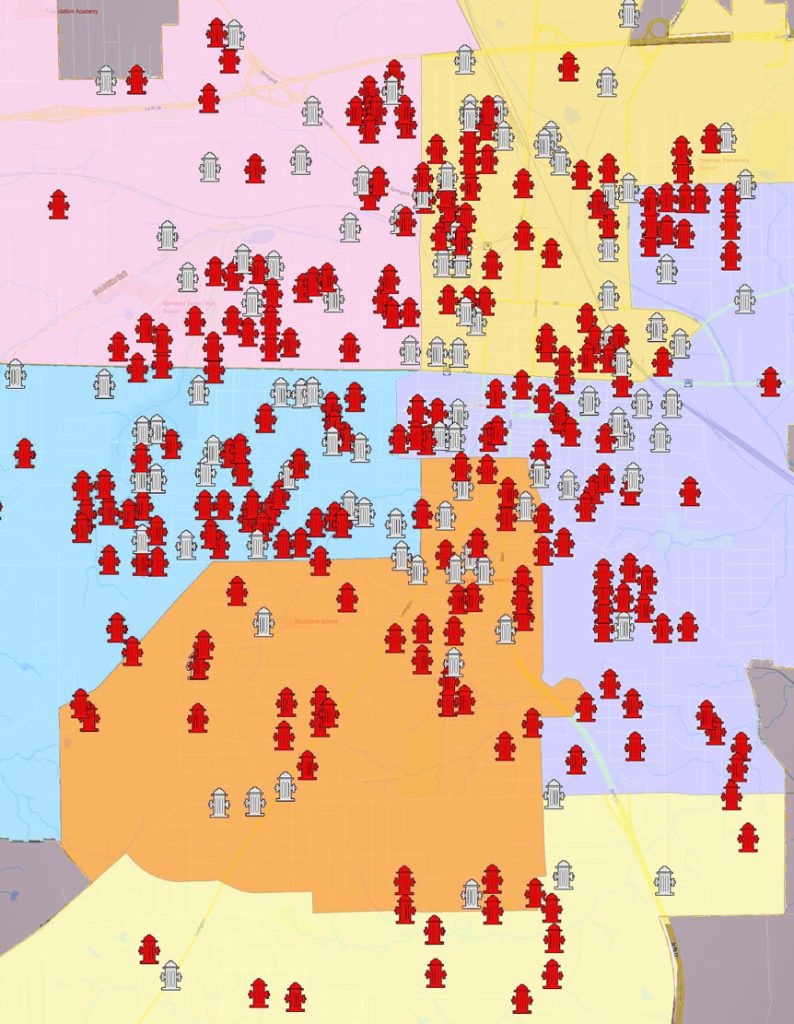
Despite not asking residents to approve the four-year tax increase, Crow said a proper water supply can make a difference for city firefighters, who responded to more than 200 fire calls in 2022, including 71 building fires.
He said a fire engine responds with 750 gallons of water on board, enough to attack a blaze for about five minutes. That gives firefighters a few minutes to hook hoses up to a hydrant.
“The first five to 10 minutes of that fire are the ones that really count. Those are the minutes that are really going to make sure that it’s gonna be a successful operation, or it’s going to be one where we’re going to have a big loss,” Crow said.
“The water supply that we need immediately for that fire is crucial. The number of hydrants that we have in the city that are either low-flow or no -flow is significant.
“That does create a hindrance because as we arrive, we’re finding ourselves in situations where we have to abandon that closest hydrant and look for another water main that has sufficient water for us to do what we need to do,” the chief said.
“That’s going to cause a delay. And a lot of times it pushes us out of that five- to 10-minute window where it really matters for us to have all the people inside the building, doing fire-fighting activities, and not driving down the road looking for the next hydrant,” Crow said.
The issue was rejected by voters in November when 52.76 percent opposed it. Miller and his group convinced City Council to put it back on the March ballot.

The tax revenue could only be used for water main replacements, similar to the Pothole Haters Tax that Miller helped push through in 1984 that only pays to resurface city streets.
If approved, the tax would generate $17 to $18 million over its lifespan and would help the city begin the process of replacing 53 miles of aging, four-inch water lines in the community.
City engineer Bob Bianchi said Thursday that amount of money would replace about 13 miles of the aging, small mains.
“It would take about four cycles (of the four-year tax) to replace all of our four-inch mains,” he said.
related reading

Crow was asked if the city could purchase a tanker truck that could bring more water to a fire scene. He said a tanker would cost about $500,000 and would require additional staffing.
“The ongoing cost of actually putting that truck in service, particularly with people, is where that becomes very expensive. In order to put that truck in service and staff it appropriately is going to cost significantly more than (just) the cost of the truck.
” And that’s an ongoing cost. That’s going to be continual. Truthfully, we are already at a point in the fire department where we need to make some very tough decisions about our overtime. It’s at a level that is not sustainable.
“So the idea of adding more staffing and more cost and more overtime to cover infrastructure problems is probably not a long-term solution. That might be something in the short term that you say, this is an emergency and we should do this to make sure that we can get through this moment. But long term, I wouldn’t be an advocate for doing that,” Crow said.
